Required Safety Gear for Kayaks and Paddleboards (Canada)
If you’re thinking about purchasing a kayak or paddleboard for touring your local lake or simply enjoying a day out on the water, you need more gear than just a boat and paddle. What most people might not know is that required safety gear isn’t just a suggestion.
In Canada, all pleasure craft, right down to small, human-powered ones like paddleboards and kayaks, are required by law to carry certain gear that reflects the minimum standard for safety. The Safe Boating Guide outlines which safety gear you need to purchase in addition to your watercraft in order to stay safe out on the water.
Safety on the Water
One only has to go to a busy lake on a sunny day to see that paddleboards and kayaks are popular for both touring and makeshift swimming rafts. They’re cheap, storable, widely available, and more durable than your standard pool floatie. Unfortunately, a large number of users are also without PFDs, signalling devices, and other basic safety equipment.
It’s easy to be lulled into a sense of safety by a warm summer day, calm water, and a well-groomed park, but a number of things can contribute to an unexpected capsize:
- Underwater Hazards
- Currents
- Collisions
- Weather
Unfortunately, there have been documented cases of drowning due to people falling from their paddleboards or kayaks while not wearing a PFD. You may think that it can’t happen to you, but:
- Wind or other factors may separate you from your kayak or paddleboard.
- Swimming ability can be compromised by conditions.
- Cold shock can compromise breathing.
- Prolonged immersion can lead to hypothermia.
The 1-10-1 Principle reflects the phases of cold water immersion. Cold shock is when sudden immersion in cold water causes an involuntary gasping reflex, followed by hyperventilation. What this means is that you may inhale water and drown in less than a minute if your head is immersed in water cooler than 15 C, regardless of swimming ability. In ten minutes, you lose the use of your arms and legs, and in one hour, hypothermia can render you unconscious. Even in the summer, many lakes and rivers in British Columbia are cold because they’re fed by glaciers or runoff from high in the mountains.
Several other factors also put individuals at greater risk of drowning:
- Not wearing a PFD
- Being alone
- Weak swimming abilities
- Alcohol consumption
If you do capsize and become separated from your gear or find yourself unable to reboard, a PFD will keep you afloat, and a signalling device will allow you to more effectively call for help.
A Lesson in Cold Water
During kayak guide training, we were required to do a paddle float-assisted rescue in the middle of winter on a partially frozen pond. Despite wearing a wetsuit, I almost immediately lost functional use of my hands and was unable to pull my paddle float out from under my kayak’s deck bungees. Luckily, my instructor helped me retrieve the paddle float to complete the exercise. Though I would have been able to self-rescue without the paddle float, it was a sobering lesson on how cold water can affect the body.
Note: These lists summarize common requirements for human-powered pleasure craft under Canada’s Small Vessel Regulations as of 2026. Certain vessels and operating conditions may require additional equipment, and requirements may change over time. Always consult the current Safe Boating Guide before heading out.
Mandatory Gear for Paddleboards and Sit-On-Top/Sealed Hull Kayaks
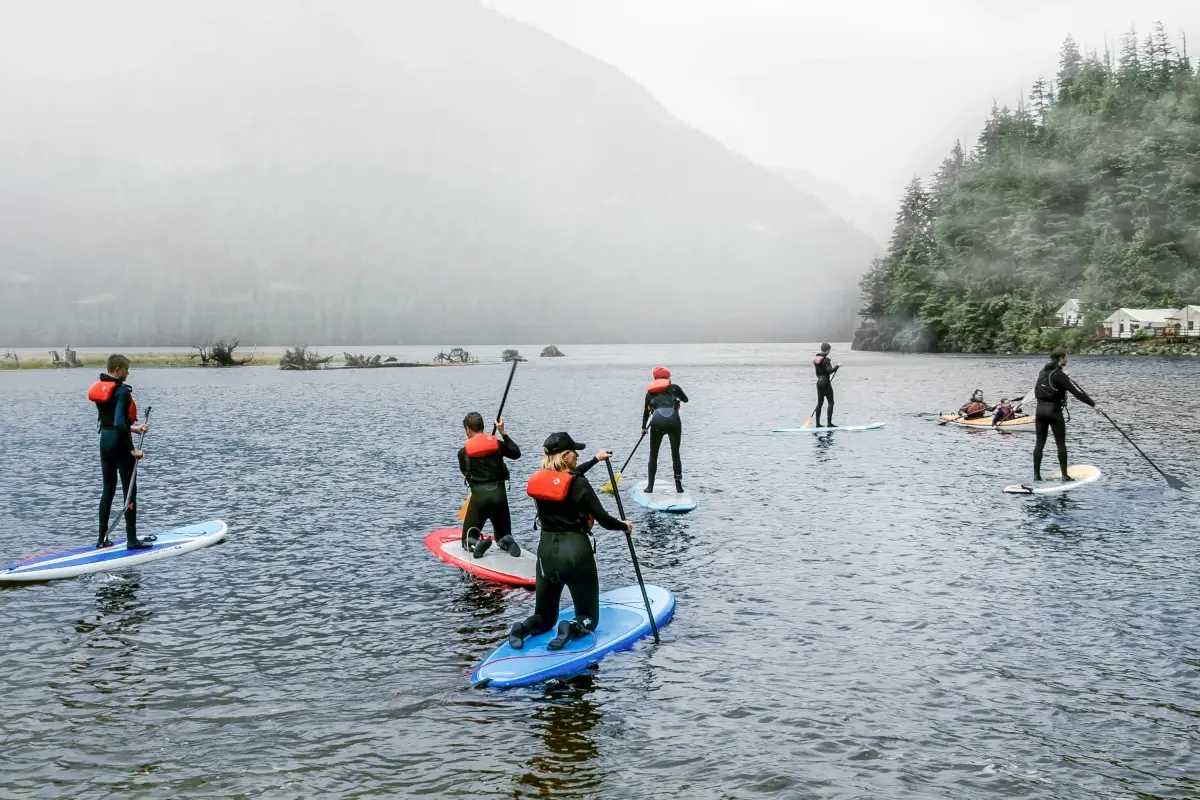
The sport of paddleboarding has quickly evolved from stand-up paddleboards (SUPs) to inflatable types that store easily and make for a fun way to get out on the lake, whether sitting, kneeling, or standing. Sit-on-top, inflatable, and other small kayaks under 15 feet (4.5 metres) in length are sometimes referred to as “play boats”, as they’re designed for use in sheltered waters. Because paddleboards and kayaks are similar in use and type, regulations for these are placed in the same category (which also includes watercycles and paddleboats). These boats must carry:
- Lifejacket or PFD (one for each person aboard)
- Signalling device (ie, whistle)
If not everyone aboard is wearing a PFD:
- 15 m of buoyant line (ie, throw bag)
If it’s more than 0.5 of a metre to reboard the vessel from the water:
- Reboarding device
If the vessel can hold enough water to capsize/does not have watertight compartments:
- Bailing device
At night or in low visibility:
- Waterproof flashlight
If the vessel is more than 6 metres long or you’re going more than one nautical mile offshore, you may be required to carry additional gear like flares or other distress signals, as outlined in the Safe Boating Guide. It’s also a good idea to tether your paddleboard to yourself while on flatwater, as it will help to keep it from blowing away from you if you capsize.
What’s the difference between a lifejacket and a PFD (Personal Floatation Device)?
● Life jackets are a type of personal floatation device designed to turn an unconscious person onto their back while in the water.
● PFDs are designed for comfort and have different buoyancy levels. A wide range is available, from women-specific designs to inflatable vests.
● When purchasing a lifejacket or PFD, ensure that it’s properly fitted and appropriate for the user’s size and weight.
Mandatory Gear for Kayaks, Canoes, and Rowboats
The next category includes pleasure craft that a person can sit inside, which usually contain bulkheads or compartments for buoyancy in case of capsize. Kayaks and canoes are typically between 15–18 feet (4.5–5.5 metres) in length and are designed for more adverse conditions, depending on the type. Rowboats come in all shapes and sizes. Vessels in this category require a little more gear:
- Lifejacket or PFD (one for each person aboard)
- Signalling device (ie, whistle)
- 15 m of buoyant line (ie, throw bag)
- Bailing device (ie, pump or bailer)
If it’s more than 0.5 of a metre to reboard the vessel from the water:
- Reboarding device
If using after dark or in low visibility:
- Navigation lights
If the vessel is over 6 metres long, additional gear is required, details of which can be found in the Safe Boating Guide. If your canoe or kayak is built of non-metallic materials and you plan to take it into an area with heavy traffic, at night, or in low visibility, a radar reflector is required. If it’s small or you aren’t taking it into a place where radar navigation is used, then it isn’t necessary.
Prevention Starts With Education
Unfortunately, despite safety gear being required, enforcement appears to be relatively uncommon. If more people were informed about safety requirements and risks at the time of purchase, more incidents could be prevented, but in British Columbia, there is currently no requirement for retailers to provide educational information. If you’re brand new to watersports, AdventureSmart is a great place to start to figure out how best to stay safe out on the water.
Cover photo by Sterling Lanier on Unsplash.