The Wilderness Disappearance of Volcanic Brown
In the days before hiking, prospectors and trappers were the original adventurers and explorers. Venturing deep into the wilderness, these were the men who learned the lay of the land, whose backcountry knowledge was second to none.
One such man was Robert Allan “Volcanic” Brown, a prospector whose disappearance in the rugged Pitt Lake wilderness is said to be tied to the legend of a lost gold mine. Was he the victim of a curse said to befall everyone who searched for the gold? Or was he simply an old man living and dying while doing what he loved?
The Early Years
Robert Allan Brown was born in 1849 in St. Martins, New Brunswick, or at least that was what was told to a 1905 newspaper. He was the seventh son in a family of seventeen children, and his father had a sawmill. Despite those clues, no records could be found in online genealogy records of his early years, which makes the beginning of Brown’s life as shrouded in mystery as the end of it.
His adventuring began at a young age, firstly when he left school at age ten to work in his father’s mill. At fifteen, he briefly worked as a sailor, then moved on to the Nova Scotia goldfields, where he learned about mining.
A jack-of-all-trades, he gradually made his way west, working on the railway, trapping, in lumber camps, and as a millwright and sawfiler. In 1881, he was a part of a lumber industry strike in Michigan.
After making his way back up to Canada and prospecting near Lake of the Woods, he came west with the Canadian Pacific Railway. He then made a dugout canoe and paddled down the Columbia River to Washington State.
Other stories ranged from being chased by a grizzly in the Selkirks to gold hunting in the Illecillewaet and trapping in the Kootenays. Eventually, though, he made his way to Boundary Country and the Similkameen, where he began prospecting in earnest.
Sunset Brown, Crazy Brown, or Doc Brown?
Volcanic Brown earned many nicknames over the years, each with its own story. After arriving in the Boundary region, he located both the Sunset Mine on Copper Mountain and the Volcanic Mine on the Kettle River near Grand Forks. The former he sold for $45,000 and bought himself some gold teeth, while the latter was condemned by engineers. A lawsuit followed, with Brown defending himself, citing fraud.
Brown’s dreams of a utopian Volcanic City at the mine evaporated, and eventually, so did his cabin there. It burned in a fire in 1913. Just over a decade later, he once again ran into trouble when he shot his friend, who was on a drunken rampage. After an inquest, it was determined to be self-defence.
Whether he lost all his coin in the mine lawsuit or spent it all isn’t clear, but at some point, he wound up in the Kootenays, selling herbal concoctions to raise money for a prospecting trip. This is where he earned the nickname of Doc, and also where the story of chasing lost gold begins to emerge.
The first version of the story is probably the one closest to the truth, as it was told to a newspaper by Brown himself when he was still alive. It was said that an Indigenous person gave him a chart with the location of gold deposits in the Pitt Lake backcountry, with samples to prove it. The individual who gave him the information died soon afterwards. Whether he fell for a con or there truly was gold out there, it was enough to send the nearly 80-year-old Volcanic Brown to the Lower Mainland in search of fortune.
Slumach and the Lost Creek Mine
There are many stories about the Lost Creek Mine and an Indigenous man named Slumach, most of them probably little more than a fairy tale. The story begins with a fact: a First Nations man named Slumach shot a man and was hanged for it. It was only later on, after his death, that stories began to emerge of Slumach knowing the location of gold in the Pitt Lake wilderness.
The story of someone coming out of the backcountry with gold and the source of it ultimately being lost is one that’s been repeated more than once throughout the province. Bill Proctor tells a similar story occurring around Alert Bay in his book Full Moon, Flood Tide, and Garnet Basque’s Lost Bonanzas of Western Canada tells about a man named Foster finding gold up the San Juan River near Port Renfrew.
Nonetheless, for men like Volcanic Brown, the temptation was too much. Like others, he went into the backcountry in search of gold, and like many who do so, ran into a heap of trouble.
Volcanic Brown Loses His Toes
In June of 1926, Brown and a party headed into the Pitt Lake wilderness, still rugged and remote country even today. Though the rest of the group returned in August, Brown stayed, making his way across a glacier and eventually ending up sleeping in a snow cave and getting frostbite on his foot.
Undaunted, he dragged himself to his cabin at Seven Mile Creek and amputated his own toes. Eventually, someone noticed he was missing, because three weeks later, he was rescued by a search party, who made a stretcher and carried him out.
Brown’s prospecting wasn’t entirely in vain. He claimed to have found deposits of high-grade aluminum. Whether true or not, he was in good spirits, telling The Vancouver Province, “I feel fine, never better. I am only anxious to get back to those hills early next year.”
Missing in the Pitt Lake Mountains
Volcanic Brown did return to the mountain, year after year, and in 1931, he didn’t come out again. Though he was last seen in August by a fellow prospector who sold him food that would last until mid-September, a search party wasn’t sent out until November.
At the time, there were two separate searches going on in the Coast Mountains, one for Volcanic Brown and the other for Nurse Mary Warburton. The latter was one of BC’s first unsolved missing hiker cases, and like Brown, autumn snow erased any trace of her. Given his age, Brown is just as likely to have been claimed by a medical event as a mishap.
Two men went in search of Volcanic Brown, who had said that he intended to cross the Stave Glacier before snow set in. The first place they checked was his cabin before moving on to search the backcountry over towards Harrison Lake.
It was a huge area, and the weather was terrible, with snow falling on sixteen days of the search, ten feet deep in some places. The searchers soon found themselves in a survival situation, having to hole up in a blizzard for several days more than once while the snow fell to ten feet deep. Eventually, conditions were too brutal to continue, and at the end of November, they returned, and the search was called off.
Though remains were found the following year near a hut on Gold Creek, speculation that they belonged to Brown was quashed when it was determined that they had been there for over a decade.
With that, Volcanic Brown’s story came to an end. He has never been found.
The End of a Legendary Man
A 1905 article about Brown describes him as a “trailblazer, pioneer, trapper, prospector, mining expert, orator, after-dinner speaker, winemaker, and loyal friend.” It was a life well-lived, full of exploration and adventure that led him across a continent in pursuit of fortune.
Like Slumach, specific connections to the lost gold emerge only after his death. The tale of his obtaining information about gold was expanded upon with claims that it was Slumach’s granddaughter whom he helped with one of his herbal concoctions. More articles sensationalize his story to include the supposed curse of death that befalls anyone who dares look for the lost gold.
Though it’s true that many people have died in pursuit of the mythical lost gold, the real curse is that of remote backcountry, rugged terrain, and bad decisions. Even hardened men as determined as the legendary Volcanic Brown are no match for unforgiving wilderness.
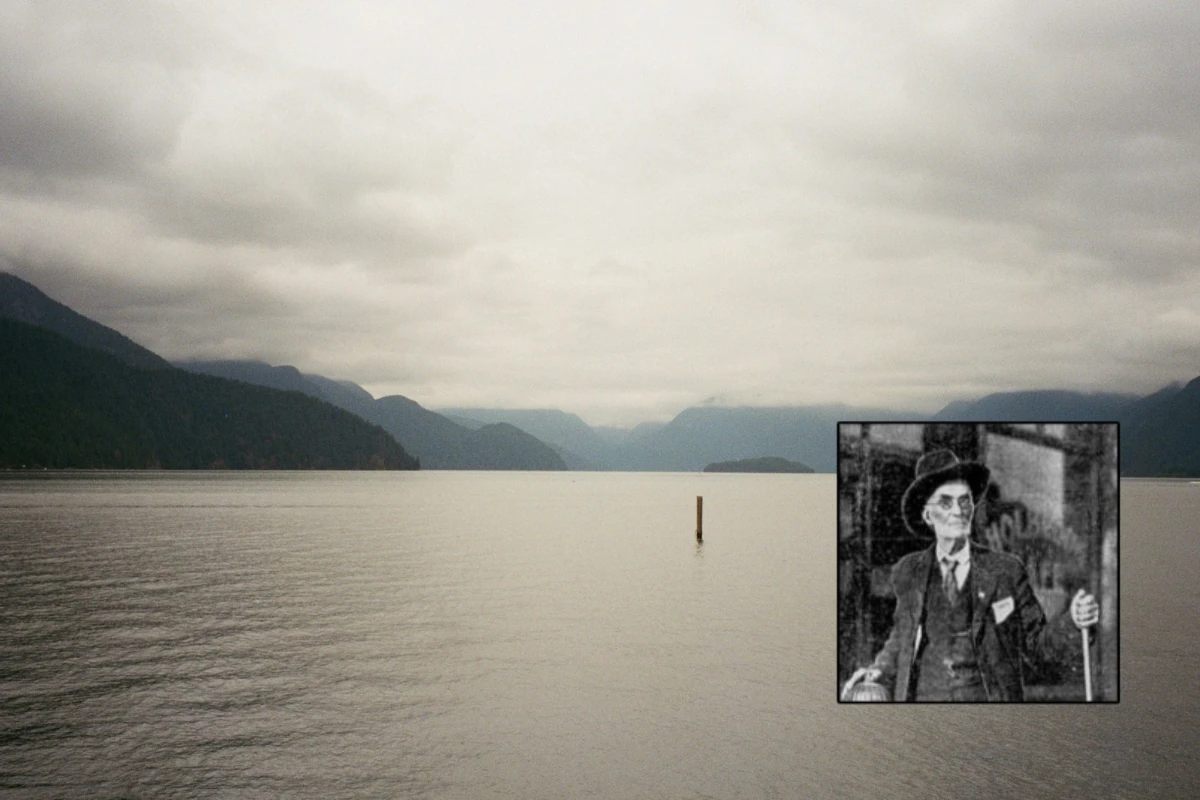
Cover image is a photo of Pitt Lake by Lauren Kan on Unsplash.