Choosing an E-Bike for Off-Road Adventures in BC
For hikers with small cars, reaching more remote trailheads can be a challenge. Even those with better-equipped vehicles may not want to risk damage on rougher forest service roads. With fuel and vehicle prices ever-increasing, more people are turning to e-bikes for off-road recreation as a more affordable option than owning a high-clearance 4WD vehicle.
In British Columbia, altered geography and extreme weather events have led to a growing number of forest service roads washed out, blocked by slides, or deactivated altogether. Getting around these spots can be a challenge, if not impossible, for vehicles, but those with off-road capable e-bikes may be able to explore farther. Choosing the right one can quickly get overwhelming, so this guide will help to break down just which one is the right fit for you.
The Basics of E-Bikes in BC
The provincial government defines an e-bike as “power-assisted cycles that have a motor to help propel the device.” These are different than electric motorized bikes, which are capable of highway speeds and require licensing. There are two types of e-bikes in BC:
Standard E-Bikes:
- Min. rider age of 16
- Max. speed of 32 km/h
- Max. power output of 500W
- Throttle assist
Light E-Bikes:
- Min. rider age of 14
- Max. speed of 25 km/h
- Max. power output of 250W
- No throttle assist
RSTBC, BC Parks, and other trail organizations use a Class 1, 2, and 3 categorization of e-bikes. Class 1 e-bikes have a maximum speed of 32 km/h, a maximum power output of 500W, and are pedal-assist only. Class 2 and 3 bikes are generally treated as motorized vehicles for trail access purposes.
As a general rule, only Class 1 (pedal assist) e-bikes and adaptive bicycles can go on mountain bike trails, whereas Class 2 and 3 can go on motorized vehicle trails and forest service roads. Municipal and regional trail networks may have their own regulations, so check local rules before riding.
ICBC does not license or register e-bikes. Some e-bikes over 500W may qualify for licensing as mopeds or light-speed motorcycles depending on their specifications. Ebikebc’s Law Guide provides a fantastic breakdown of current regulations and ways to legally ride a higher-wattage e-bike. Regulations surrounding e-bikes will likely continue to evolve.
Choosing an E-Bike for Backcountry Adventures
British Columbia’s mountainous terrain places greater demands on an e-bike’s motor and battery. Riders planning to tackle long climbs should pay attention to torque ratings, motor type, and battery capacity in addition to wattage. For those who plan to simply explore flatter backroads in valley bottoms, a standard e-bike will likely suffice. Those planning on driving long distances on forest service roads and e-biking the remainder of the way to a trailhead, the weight of the e-bike and rack capabilities come into play.
- E-bike ranges typically fall between 30 – 100+ km. Range claims are often optimistic.
- E-bikes are heavier than regular bicycles, weighing in at 45 – 80 lbs (20 – 36 kg) on average. This makes them more difficult to pedal back if the battery does run out.
- Prices typically range from $1000 – $10,000+. Rebates are sometimes available in BC.
Questions to Answer Before Purchase
How far can the e-bike go on a charge? This depends on the battery and will also be affected by terrain, pedalling, rider weight, additional gear, mode used, temperature, and even headwinds.
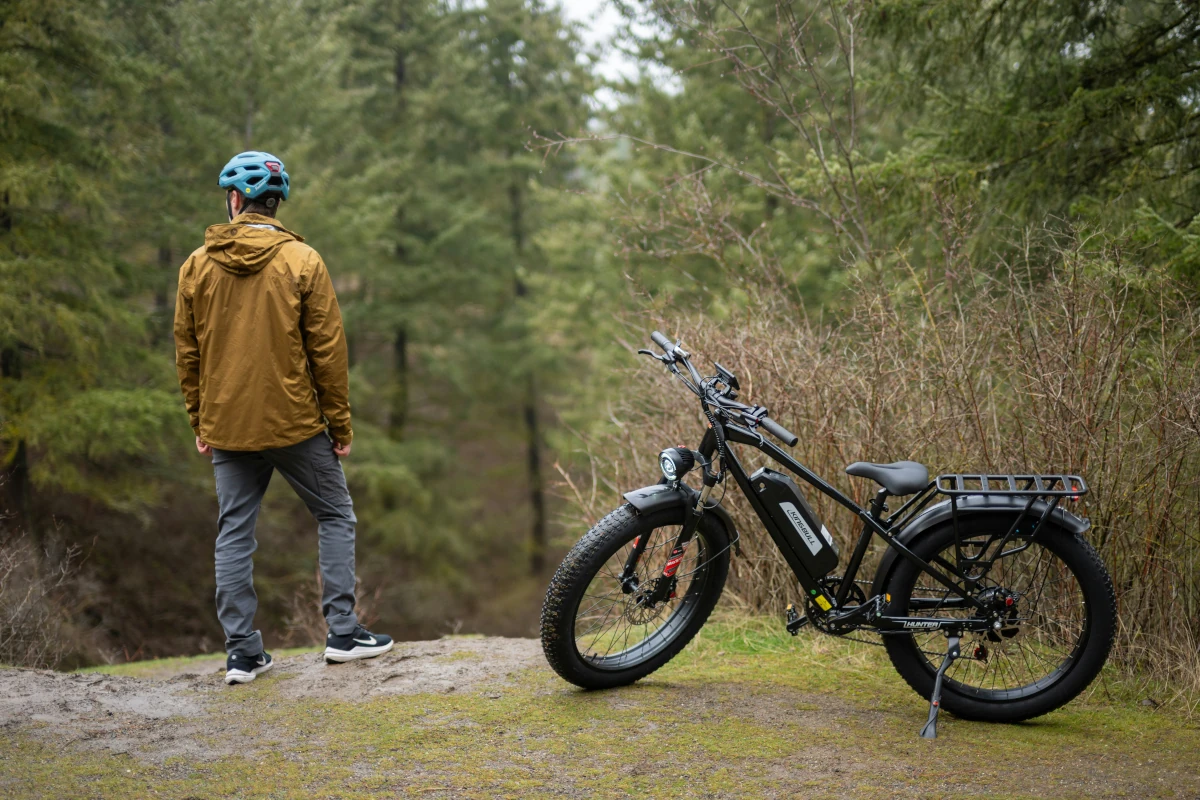
Fat tires or regular tires? Fat tires perform better on off-road terrain, including loose gravel, mud, sand, and snow, but are heavier. They are slower on hard-packed terrain. Regular tires are lighter, faster, and better suited for trails and paved roads.
Hub-drive motor or mid-drive motor? Hub-drive motors are usually cheaper and simpler, while mid-drive motors generally climb better and perform better on steep roads.
What about torque? Torque is the force that helps an e-bike accelerate and climb hills. Higher torque can make climbing easier, particularly on steep grades or rough roads.
What kind of weather do you plan on riding in? West coast rain may require a cover, while Rocky Mountain cold will affect battery performance. Check the bike’s IP rating before purchase.
Are replacement batteries and other parts readily available? Consider whether batteries and other parts will be readily available and affordable over the long term. Lithium batteries can be expensive to replace.
Is there a local shop that can repair the e-bike? Not all communities will have someone to repair broken e-bikes, so check where your nearest repair shop is located.
What about charging logistics? Can it be charged from a campsite, vehicle, or power station?
Can it take more than one battery? You may want to consider having more than one battery if travelling long distances in the wilderness.
Is the battery external or internal? External batteries can be removed more easily.
Do you need accessories? Many e-bikes come with integrated lights, monitors, and cargo carrying capabilities.
Should you be fitted for an e-bike? Just like a regular bike, trying one out to see how it fits your body is the way to go.
How will you transport it? E-bikes are significantly heavier than conventional bicycles and may exceed the weight limits of some bike racks.
E-Bike Racks and Rough Roads
One of the biggest factors for those taking their e-bikes off-road is how it will be transported. While those with trucks and SUVs may be able to fit their e-bike inside their vehicle, other options include carrying it on a rack.
Since e-bikes are heavy, the rack should be able to support the weight of the bike. Before doing so, check the rack’s weight rating. Those planning on going off-road should also consider that racks will be under additional stress on backcountry roads where bouncing and rattling can cause them to break. Racks should also not sit low to the ground, as they can potentially collide with the ground on rougher roads.
It’s also a good idea to remove the battery when transporting the e-bike. Doing so reduces the chance of a lithium fire in case of an accident, and will also make it lighter.
Securing Your E-Bike at the Trailhead
Depending on how remote you go, the risk of securing your e-bike at the trailhead can vary. Some outdoor recreation areas on BC backroads can be a hotbed of illegal activity, while others are nearly deserted.
For securing e-bikes at a trailhead, hikers might need to get creative. Stashing them in trees or bushes will only work if there’s heavy forest cover. For alpine areas and other places with open forest, trail users might need camouflage or heavy chains and locks.
To help track your e-bike if it does get stolen, consider hiding an AirTag or other tracker on it. Keep in mind that cell service is often unavailable in remote areas of the province, which may limit the usefulness of tracking devices. You can also register your e-bike with Project 529 Garage, which can help locate and identify it in case of theft. Photograph and record the serial number before taking it into the backcountry.
Removing the battery can also deter theft and reduce the value if it’s stolen. If possible, consider stashing the bike and the battery separately.
E-Bike Adventures on BC’s Backroads
E-bikes are becoming an increasingly popular alternative for accessing outdoor recreation in the backcountry. BC’s industrial history means that it’s not just trails, but old mines, ghost towns, fire lookouts, plane crashes, old mines, and countless roads to access and explore.
For those looking for real-world examples of what is possible with an e-bike in British Columbia, Destination Adventure uses a Himiway Cobra Pro to explore remote locations, while Foresty Forest regularly incorporates a Pedego e-bike into his backroad explorations. Their adventures demonstrate just how useful an e-bike can be for extending the reach of a small vehicle.
While most riders won’t be travelling quite as far into the backcountry, the principle is the same. Whether bypassing a washout, reaching a remote trailhead, or exploring an old fire lookout, an e-bike can open up new opportunities for outdoor recreation without the expense of owning a dedicated off-road vehicle.
Cover photo by KINGBULL Bikes on Unsplash.