The Reality of Off-Grid Living in BC
Many nature-loving, noise-hating outdoorspeople like myself dream of owning a remote, off-grid paradise in British Columbia. On paper, it sounds simple: a piece of raw land where you can build something out of Weird Homes: perhaps a cob house, or a hobbit house, an Earthship, or maybe just a simple cabin. Basically, a place where you can enjoy puttering around on projects, watch birds, and otherwise ignore modern society.
The reality of finding a place where you can actually do this is much more complicated. While a few cheap plots of land may still exist, building and even living on them isn’t as simple as buying them and then doing what you want.
Too Many Rules? Zoning, Codes, and RV Living
Zoning is what determines what you can and can’t do with your land. It’s defined at the local level, meaning what zoning your land has and what that designation means varies between municipalities and regional districts. Some parcels of land may have no zoning, whereas others may be rezoned in the future.
Rural residential zoning, for example, usually means you can build a home on the property. Size, distance from the lot line, and other requirements will be specific to the municipality or regional district.
If you’re building a home, it’s usually required that it has a water supply and approved sewage disposal. For many rural properties, this means a well and septic system. There are specifications for how far each of these things can be from the home, the lot line, neighbouring homes, and waterways. Many rural parcels of land may be too small in size to accommodate both of those.
If building a cabin is too complicated, you might think an easy solution is to put an RV on the land and live in it. Legally, you can usually do so for a short period of time while building a permanent home. While there are some areas where it’s not enforced, living full-time in an RV on private land is heavily restricted in BC, though different regions may have different rules and enforcement. Tiny Homes may be classified as RVs.
There are regional districts in BC that don’t have a building department, so they don’t issue building permits or send out inspectors. Even if building permits aren’t required, buildings still must be built to code; electrical permits are mandatory, septic systems must also be to code and done by a professional, and wells may need to be registered.
A dry cabin is one without indoor plumbing or water, and is typically paired with an outhouse. While some regional districts may allow them, there may still be restrictions and rules to follow. The best thing to do is to check local requirements before buying land or building.
An off-grid dream quickly begins to look impossible when you start getting into rules, regulations, and land scarcity. At this point, you might be wondering if you can just run away and live in the woods somewhere, but unfortunately, it isn’t that simple.
What About Crown Land Leases?
Though the government tends to look the other way when it comes to cabins and other structures built by recreationalists, living on Crown land is another story. Basically, it’s illegal to build a home on crown land in BC unless you have an appropriate tenure or other authorization. Squatters’ Rights do not exist in BC.
Applications from individuals for building a home on a piece of land aren’t accepted anymore, so you can no longer obtain a Crown land lease to build an off-grid cabin or homestead. There are limited exceptions. Existing leasehold properties may be available for purchase, but they come with risks.
Past crown land lease properties that are for sale are generally priced lower than freehold listings. Annual rent for these properties is a percentage of the assessed value of the land. A leased property may not be covered by rent increase protection, and a sale may trigger an assessment and, in turn, a rent increase. Always check the lease agreement before buying. There is no guarantee that the lease will be renewed when it expires.
Questions to Consider Before Buying Land
- Loans: Are you buying outright or getting a mortgage? Undeveloped land requires a higher down payment (20-50%) and also comes with a higher interest rate on the loan.
- Is your intended use permitted?
- Zoning: What is it currently zoned, and are there any plans for rezoning in the future?
- Is it in the ALR (Agricultural Land Reserve)? ALR land comes with additional restrictions.
- Are there any restrictive covenants and easements?
- Does it have a clear title? Are there any debts or legal issues tied to the land?
- Is there any soil contamination from past uses?
- If it has a well, has the water been tested?
- Is the land affected by changing seasons? Some land may flood and be unusable for part of the year.
- Is there a slide risk? Are the slopes stable? Are there any sinkholes? Any erosion? These are especially important if the property is sloped or next to a body of water.
- What services (garbage pickup, etc.) are available, if any?
- How much are the yearly taxes?
- Are there water, sewage, and electricity hookups nearby?
- What water source do you intend to use? Can you use it? Do you need to obtain water rights?
- Is the lot size large enough to put in a septic system if required? What about a well? What about both?
Risks and Self-Sufficiency
Living in a remote area comes with risks. Medical care is hours away. You’ll be sharing your space with wildlife. Summer wildfires can easily destroy everything you’ve built. You may be snowed in for weeks, as forest service roads that aren’t in use may make your property inaccessible. Getting food is no longer a quick trip to the store. Like it or not, social contact is critical for mental health.
Though areas with cell service and satellite-based communication devices can keep you connected to the outside world, weather, tree coverage, and other conditions may affect how they work. Living in the bush means being prepared. If the worst happens, what’s your safety plan?
Living the Off-Grid Dream
Knowing all the rules and risks, is it even possible to live off-grid and build your own home or homestead in BC?
I’ve been sketching out my off-grid paradise since I was seventeen. Sometimes it was a cob house, sometimes it was a castle tower, and sometimes it was just an old wooden boat stuck on the property and turned into a dwelling. Ideally it would be in some remote coastal region, but I’d settle for the beautiful forests of the Cariboo. With sky-high real estate prices and goalposts that keep moving, it seems impossible.
Living the dream is Shawn of Cabin River Outdoors, who managed to purchase an isolated parcel of land in BC several years ago. Though there’s no road access to his land, he’s managed to clear land, build several cabins, put in a garden, dig a well, and even bring in a portable sawmill, all only being able to get there via trail or water. Is it all scenery and peace? No. It’s a hard life, and hasn’t been without numerous mishaps. On the flip side, the difficulties do make for engaging content on YouTube, which is his primary source of income. Cheap, isolated parcels of land are incredibly rare, if not impossible to find, making him by far an outlier.
Having all but given up on my own dream of doing the same, when I saw what he was doing, I was instantly back on my buying land and running off to live in the woods BS. While finding the perfect piece of land can be difficult enough, understanding the rules and regulations involved is a crucial piece of the puzzle.
Is living in the woods more difficult than ever before? Sure, but it can still be done, so long as you’re equipped with the right knowledge. Keep chasing the dream.
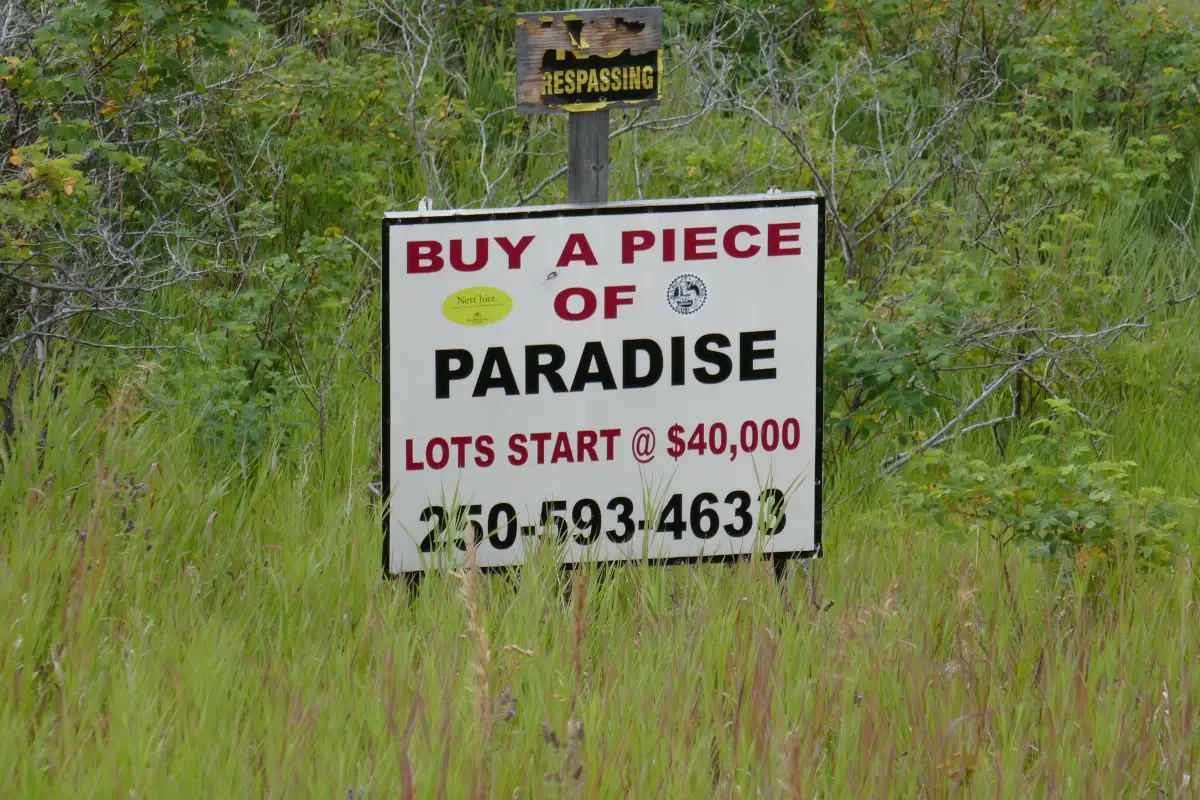
The cover image was taken in the Cariboo in 2024, advertising lots for sale near Lac Des Roches. The information on the sign is now out-of-date.